
defense
Bundeswehr supports Poland in protecting NATO’s eastern border
Updated August 20, 2026 – 4:36 p.mReading time: 3 minutes

German and Polish soldiers work together to secure Poland’s eastern border. What the Bundeswehr deployment means for NATO deterrence.
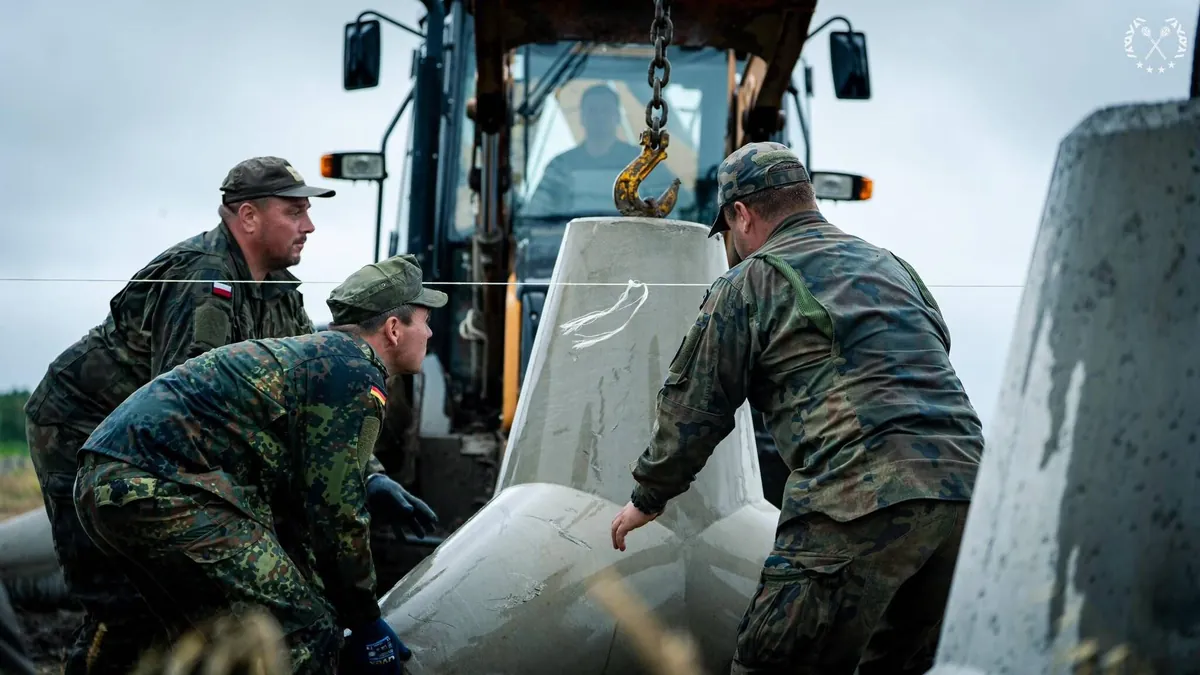
The anti-tank barriers lie in three rows on the muddy, furrowed field. There is only one gap left. A backhoe loader lifts one of the multi-ton concrete elements from a military truck. German and Polish soldiers work together and make sure that the “tank hedgehog” is lined up perfectly.
Two hundred meters from here, barbed wire and tall birch trees mark Poland’s border with the Russian exclave of Kaliningrad. It is also the eastern border of the NATO. It should be fortified – and Bundeswehr soldiers are helping. Major General Tilo Maedler stretches his chin in the direction Russia. “If they see us – then they will immediately know who they are dealing with. This also serves as a deterrent.”
Since July, around 40 soldiers from a reinforced machine engineer platoon have been in the northeast of Poland in use. Together with the Polish army, they dug an anti-tank ditch and set up anti-tank barriers. The deployment is planned until the end of October.
Poland is investing billions in the “Protective Shield East”
According to Prime Minister Donald Tusk, Poland is “safer than ever” on its eastern border. EU and NATO member Poland is one of the main supporters of those attacked by Russia Ukraine and also sees himself Moscow threatened. It is therefore investing billions in the so-called “Protective Shield East”, a fortified defense line on parts of its eastern border.
By the end of this year, the Polish Ministry of Defense wants to secure around 250 kilometers of the eastern and northern border. Concrete fortifications, electronic monitoring systems and storage facilities for engineer equipment are planned. The European Union is helping to finance the project through its “SAFE” defense program.
Anti-tank barriers as a deterrent, mines for emergencies
“The effort it would take for a potential enemy to get through here would be enormous,” explains Major Martin, who, according to Bundeswehr regulations, can only be referred to by his first name. The pioneers dug a deep ditch just behind the border fence. “It’s there to ensure that a tank drives in and doesn’t come out again.” Should this succeed, there will be two rows of three “tank hedgehogs” to overcome.
The space between the barriers, which is around a hundred meters wide, has a purpose. “In the event of an imminent attack, we can lay mines here,” explains General Stanislaw Czosnek of the Polish army.
In February 2026, Poland withdrew from the international treaty banning landmines, which Russia and the USA never signed. Poland ratified the Ottawa Convention in 2012 and destroyed its mining reserves. After the start of the Russian war of invasion against Ukraine, it announced its withdrawal last year – together with FinlandEstonia, Latvia, Lithuania and Ukraine. According to Prime Minister Tusk, it will soon be able to mine its border with Kaliningrad within 48 hours.
