
Environment
Climate summit: New draft text does not mention oil and gas
Updated 11/22/2026 – 5:16 amReading time: 4 minutes

After well over 30 hours of extension, the conference in Antalya has a new draft final declaration. This acknowledges a bitter truth.
After tough negotiations that lasted deep into the night, the World Climate Conference is heading towards the Türkiye towards their finale. In the morning, the almost 200 states should vote on a new draft of a final declaration. It recognizes that global warming can no longer be stopped at the critical mark of 1.5 degrees.
At the same time, oil, coal and gas are not explicitly mentioned in the ten-page paper by the conference management – contrary to what the German delegation and many climate protection associations had hoped. However, there is a general cross-reference to one as early as 2023 Dubai The decision was made that the world should gradually say goodbye to these fossil fuels – the main drivers of the escalating climate crisis.
Greenpeace: “None of this is acceptable”
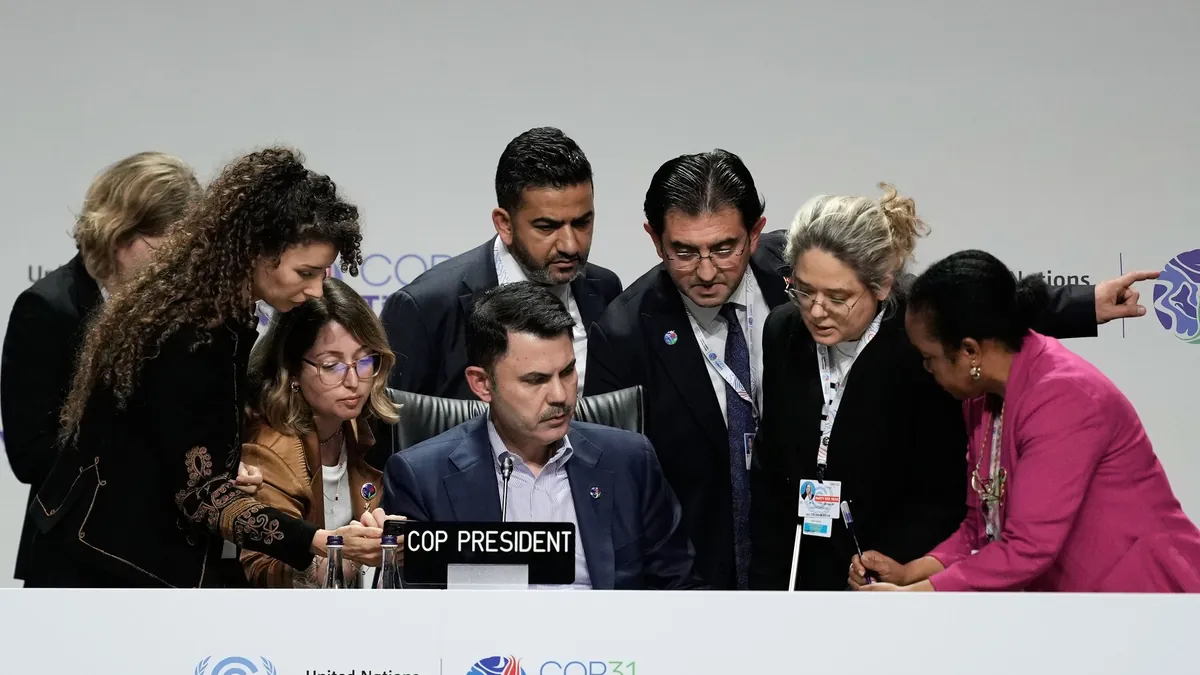
The draft was released early this morning, about 32 hours after the conference was scheduled to end on Friday. According to conference president Murat Kurum, the delegations of almost 200 states have time to examine the matter, then the plenary session is scheduled to meet at 9 a.m. local time (7 a.m. CET) to vote. Kurum appealed to the climate diplomats’ willingness to reach agreement and their ability to compromise, despite two weeks of negotiations Antalya were divided on many issues until the end. “The rifts between us are closing,” he said.
In an initial reaction, the managing director of Greenpeace Germany, Martin Kaiser, called it unbelievable that the current negotiating text still lacks any mention of the fossil energy sources coal, oil and gas. Instead, underground CO2 storage “on a gigantic scale” should extend the business model of the major oil and gas companies into the next century. “None of this is acceptable and must not be accepted by Environment Minister (Carsten) Schneider and the EU together with the island states and vulnerable groups of states.”
1.5 degree target is broken
The text expressly recognizes that the States in Paris The goal set for 2015 will be to limit global warming to, if possible, 1.5 degrees compared to pre-industrial times. However, the aim is to limit the extent and duration of this excess, it goes on to say. Staying below the critical mark is important because, according to climate science, the most catastrophic consequences of the climate crisis could be averted. Global warming is already causing more intense and frequent heat waves, droughts, storms and forest fires.
According to a UN report, breaking the 1.5 degree mark is now inevitable; in the best case scenario, 1.7 to 1.8 degrees can be maintained until the middle of the century. But this would require unprecedented reductions in greenhouse gas emissions, which are not yet apparent: by 18 percent by 2030 and 45 percent by 2035.
Target for accelerated electrification
The paper also takes up the goal of accelerated electrification proposed by the host. By 2035, the share of electricity in final energy consumption should increase from 23 to 35 percent. This refers to the energy that households, industry, road users, service providers, data centers and farmers actually use. The idea: More cars, heating systems and industrial plants worldwide should run on electricity instead of burning fuel or gas.
