
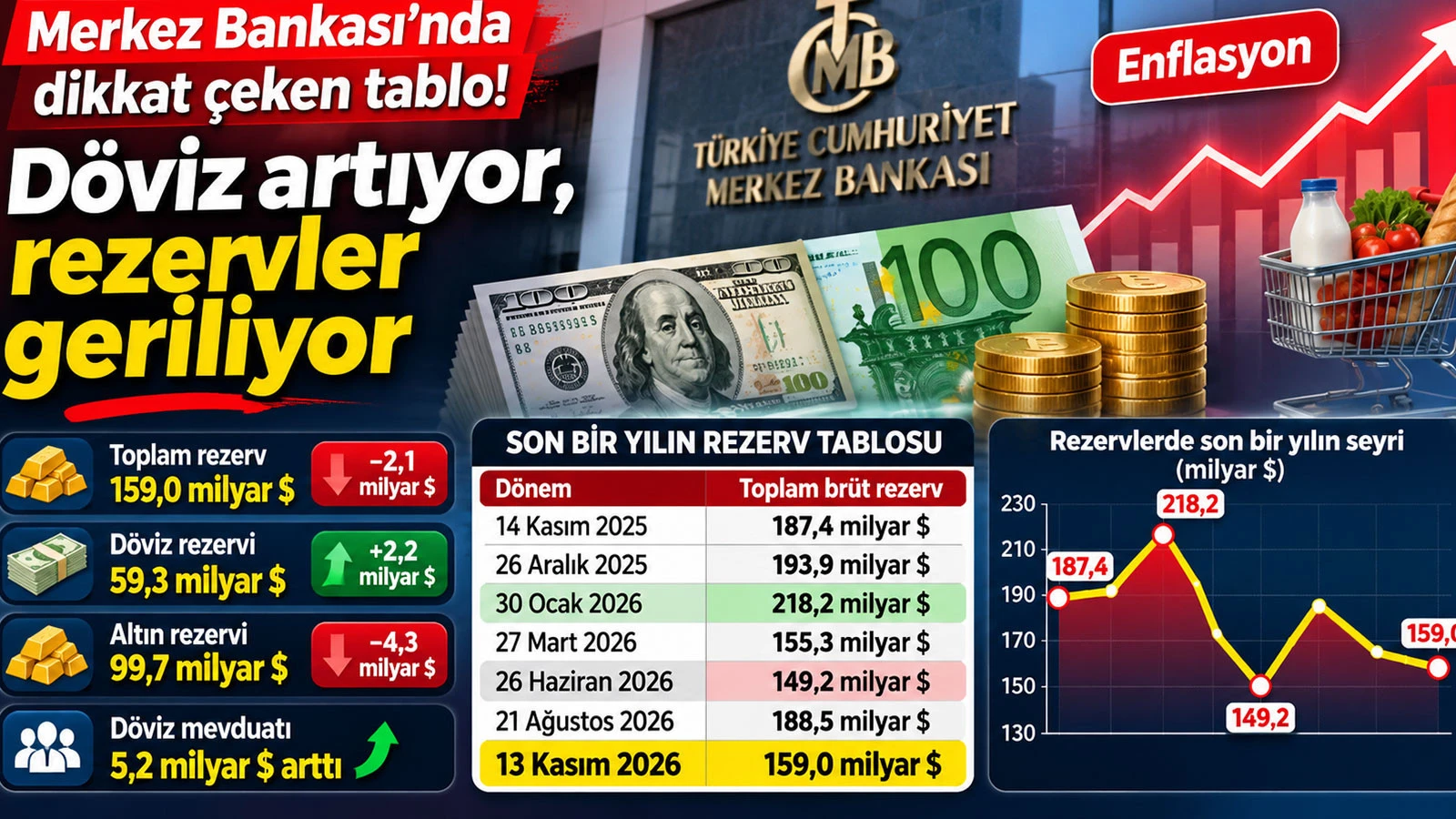
The latest data of the Central Bank revealed a remarkable picture in terms of the country’s foreign exchange accumulation, foreign debt and foreign investors’ preferences. While the Central Bank’s total reserves decreased by 2.1 billion dollars in the week of November 13, foreign currency deposits in banks increased by 5.2 billion dollars, adjusted for exchange rate and price effects. During the same period, foreigners continued to buy Turkish stocks and government bonds and sold private sector bonds. Türkiye’s short-term external debt also increased to 173.1 billion dollars at the end of the third quarter. These developments, which are different from each other, raised the question of the direction in which foreign exchange demand and money movements in the economy are moving.
2.1 BILLION DOLLAR DECLINE
The Central Bank’s total gross reserves decreased from 161.1 billion dollars to 159 billion dollars in the week of November 13. However, when we look at the details, a different picture emerges. While foreign exchange reserves increased by 2.2 billion dollars to 59.3 billion dollars, the dollar value of gold reserves decreased by 4.3 billion dollars to 99.7 billion dollars. Thus, the decline in gold was the determining factor in the decline in total reserves. Analysts point out that the decrease in the value of gold reserves does not mean that the Central Bank sells the same amount of gold. The decline in gold prices in international markets can also reduce the total value of reserves.
DECREASED BY 28.4 BILLION DOLLARS
The change in reserves is not limited to the last week only. Total reserves, which were 187.4 billion dollars in the same period last year, completed 2025 with 193.9 billion dollars. Reserves, which reached 218.2 billion dollars at the end of January 2026, decreased to 149.2 billion dollars in June. Total reserves, which rose to 188.5 billion dollars again in August, dropped to 159 billion dollars in mid-November. Thus, there was a decrease of approximately 28.4 billion dollars in the last year.
NET $41.3 BILLION
Experts point out that not all of the Central Bank’s $159 billion gross reserves are the bank’s own resources. When liabilities related to reserves are excluded, net reserves decrease to 41.3 billion dollars, and when swaps, which are temporary currency exchange transactions, are excluded, they decrease to approximately 28.5 billion dollars. While net reserves increased by 83 million dollars in the last week, experts state that in addition to gross figures, net and swap-excluding data should also be taken into account to evaluate the real situation of reserves.
BANKS’ TRANSITION TO FOREIGN EXCHANGE
One of the notable developments in the latest data was in foreign currency deposits in banks. Foreign currency deposits of citizens and companies increased by 5.2 billion dollars in the week of November 13, adjusted for exchange rate and price effects. This was the highest weekly increase recorded since July. As of mid-September, the total increase reached 12.2 billion dollars. A significant part of the increase in the last week stemmed from company accounts.
EXTERNAL DEBT 173 BILLION DOLLARS
Türkiye’s short-term external debt increased by 1.5 percent to 173.1 billion dollars at the end of the third quarter of the year. 75.1 billion dollars of this debt belongs to banks, and 73.6 billion dollars belongs to sectors other than banks. The debt of banks increased by 0.6 percent and the debt of other sectors increased by 2.3 percent. However, Türkiye’s foreign debt, which will be paid within the next year, is not limited to this figure. When the part of previously long-term debts that must be paid within one year is added, the total amount reaches 240.2 billion dollars.
“IT DOES NOT MEAN CRISIS”
Corporate Economics Expert Gülsev Duran stated that the latest data point to different developments in the economy and said, “While the Central Bank’s total reserves decreased, foreign exchange reserves increased. Short-term foreign debt also increased. However, these data alone do not mean that there will be an economic crisis or that companies will not be able to pay their debts.”
