
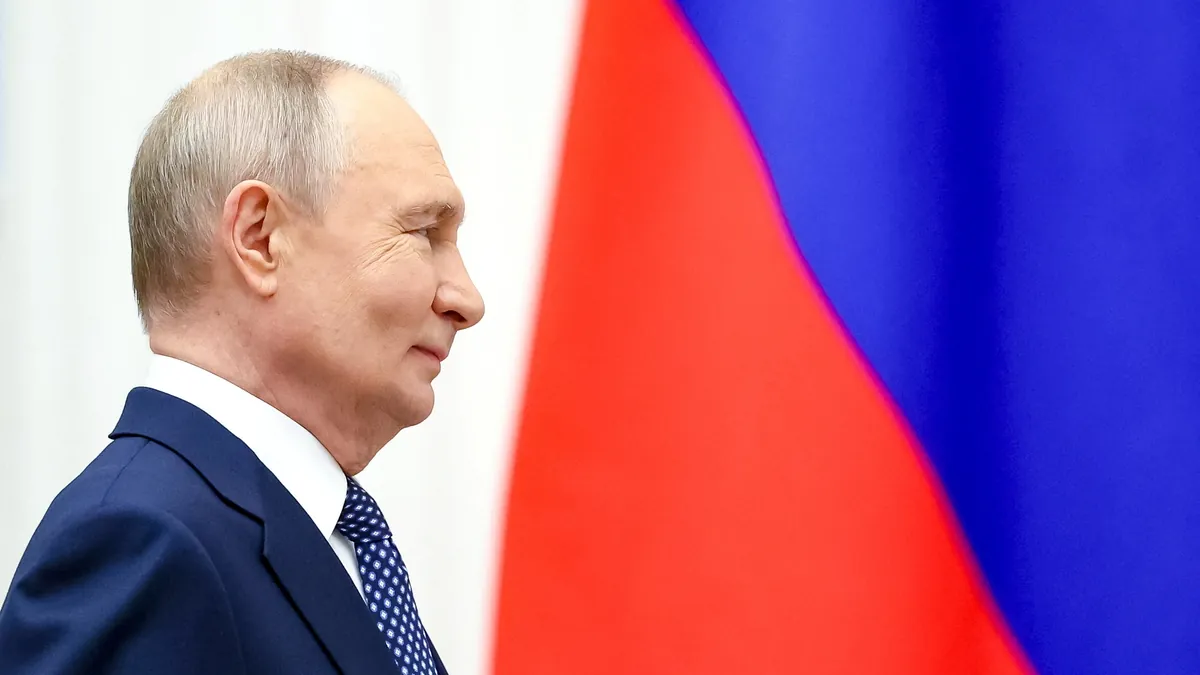
Vladimir Putin is considered the driving force of the war against Ukraine. But that alone does not explain Russia’s aggression against its neighboring country and Europe. Historian Martin Schulze Wessel says what else lies behind it.
Russia is highly aggressive and on an expansion course. Nevertheless, the hope of some people in Germany remains that peaceful relations with the giant country will be possible again in the future. This is a fatal fallacy, warns Martin Schulze Wessel. According to the historian, Russia is not attacking Ukraine because it feels threatened.
Why is Russia behaving so aggressively? What does the Kremlin want to achieve? And when might real peace with Russia be possible? Martin Schulze Wessel, author of the book “Why Russia Won’t Stop,” answers these questions in an interview.
t-online: Professor Schulze Wessel, there is still hope in Germany that Russia could end its aggression and that “normal” conditions will be possible again. Is there the slightest hope?
Martin Schulze Wessel: This is an illusion. At least under Russia’s current political leadership Vladimir Putin at the top. “Russia’s border ends nowhere,” Putin said in 2016, followed in 2025 by saying, “Wherever a Russian soldier’s boot steps, that is ours.” In doing so, Putin reveals his imperial program and makes a terrible threat. Some say war is embedded in Russians’ DNA. No, there are other reasons for Russian aggression.
This is what your new book “Why Russia Won’t Stop” is about. Why won’t Russia give up its aggressive policy?
Expanding one’s own territory was already considered an essential part of one’s identity in Russia in the 19th century. Key politicians and scientists understood Russia as an empire that was constantly expanding. Today this is being taken up again. If it were otherwise, Putin’s statements just quoted would make no sense. The demand to push one’s own boundaries at the expense of the… Ukraine is supported by large sections of the population in Russia. We shouldn’t have any illusions about that. That’s why the basic message of my book is the sobering thesis that Russia won’t stop: Even if Putin agrees to a ceasefire with Ukraine, which he has so far stubbornly refused to do, Russia will remain a state whose aggressiveness we have to reckon with for the foreseeable future.
To person
Martin Schulze Wesselborn in 1962, teaches history of Eastern and Southeastern Europe at the Ludwig Maximilians University in Munich and is director of the Collegium Carolinum Institute, which researches the history of the Czech Republic and Slovakia. Together with his Ukrainian colleague Jaroslaw Hrytsak, Schulze Wessel founded the German-Ukrainian Historical Commission in 2014. His book was recently published “Why Russia won’t stop. Seven theses” published by CHBeck.
What does this mean that German and European efforts to improve Russia’s deterrence must remain a long-term investment?
In any case. It’s about confronting Russia with strength, determination and consistency. Where the Russian leadership senses weakness, it sees opportunities. The Russian war against Ukraine might have been avoided if the West had not reacted so ambivalently to Russian aggression following the Russian occupation of Crimea in 2014. Russia took Crimea, the West imposed sanctions, but continued to buy oil and gas from the Kremlin. From Nord Stream 2 not to mention still. That was completely the wrong signal.
