
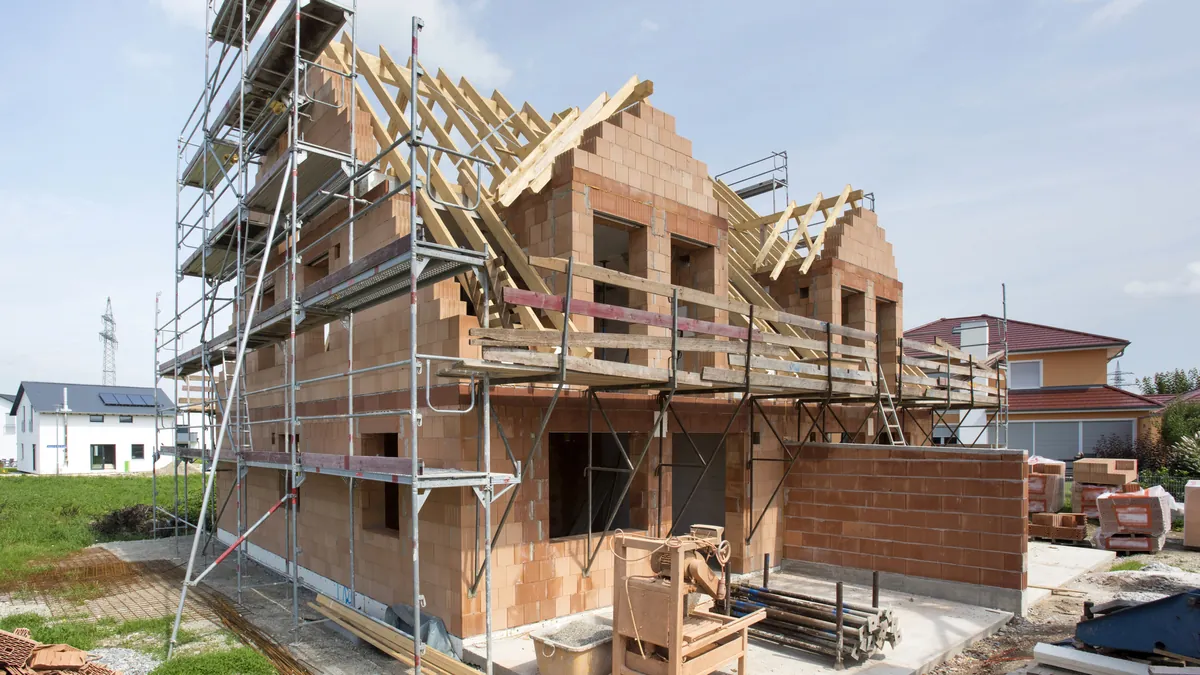
Building interest rates rise well above 4 percent
Why property is becoming more and more unattainable
09/14/2026 – 2:02 p.mReading time: 3 minutes

Rising costs are making buying home more and more difficult. Why building interest rates are rising now of all times and what that means for your financing.
Germany is at the bottom of the list when it comes to home ownership in Europe. According to the Federal Statistical Office, the home ownership rate in this country is only 44 to 46 percent, far behind countries like Spain (76 percent), Poland (85 percent) or the Slovakia (93 percent). And the prospects for change are bleak.
Building interest rates, which are a crucial factor in real estate financing, have risen significantly. Anyone who wants to finance a house or apartment today has to expect loan interest rates of 3.99 to 4.62 percent – a considerable burden for many prospective buyers.
ECB and bonds: The main causes of the increase in prices
The decision of the European Central Bank (ECB) to raise the key interest rate to 2.5 percentaround the inflation Combating this also has an indirect but noticeable impact on building interest rates. Although building interest rates are primarily based on the yields on German federal bonds and Pfandbriefe, these react strongly to the monetary policy signals of the ECB. Rising key interest rates are causing investors to demand higher returns on government bonds. This drives up the banks’ refinancing costs – and thus also building interest rates.
This is how building interest rates and key interest rates are related
The building interest rates are not directly linked to the key interest rate, as real estate loans often have a long fixed interest rate of 10 or 15 years. Instead, building interest rates are based on the yield on 10-year German federal bonds. These returns, in turn, depend heavily on the market’s expectations of ECB policy. Rising key interest rates lead to higher yields on government bonds – and thus to rising building interest rates.
According to Interhyp, the building interest rates for a loan with a 10-year fixed interest rate are currently an average of 4.0 to 4.2 percent. If you have little equity and finance for 20 years, you can even pay up to 4.62 percent. For many households, the dream of owning their own home is becoming even more difficult to achieve.
The interest table shows the effective annual interest rate calculated by Interhyp.
| Fixed interest rate tranche | Loan-to-value ratio <70 | Loan-to-value ratio =80 | Loan-to-value ratio >90 |
|---|---|---|---|
| 10 | 3.99% | 4.11% | 4.38% |
| 15 | 4.25% | 4.31% | 4.58% |
| 20 | 4.33% | 4.39% | 4.62% |
Note: The loan-to-value ratio is one of the most important key figures for banks when financing real estate. It indicates the percentage ratio between the required loan amount and the loan value of the property determined by the credit institution. Rule of thumb: The lower the loan-to-value ratio, the more equity the buyer brings in. The bank rewards lower risk with cheaper interest rates.
High building interest rates were already priced in
Dirk Eilinghoff, interest rate and real estate expert at “Finanztip,” explains that the ECB’s latest interest rate decision was no surprise. “The building interest rates have long anticipated the decision,” says Eilinghoff. It had already risen in the weeks before the ECB decision Return the 10-year federal bond rose by 0.5 percentage points – and building interest rates followed this trend.
