
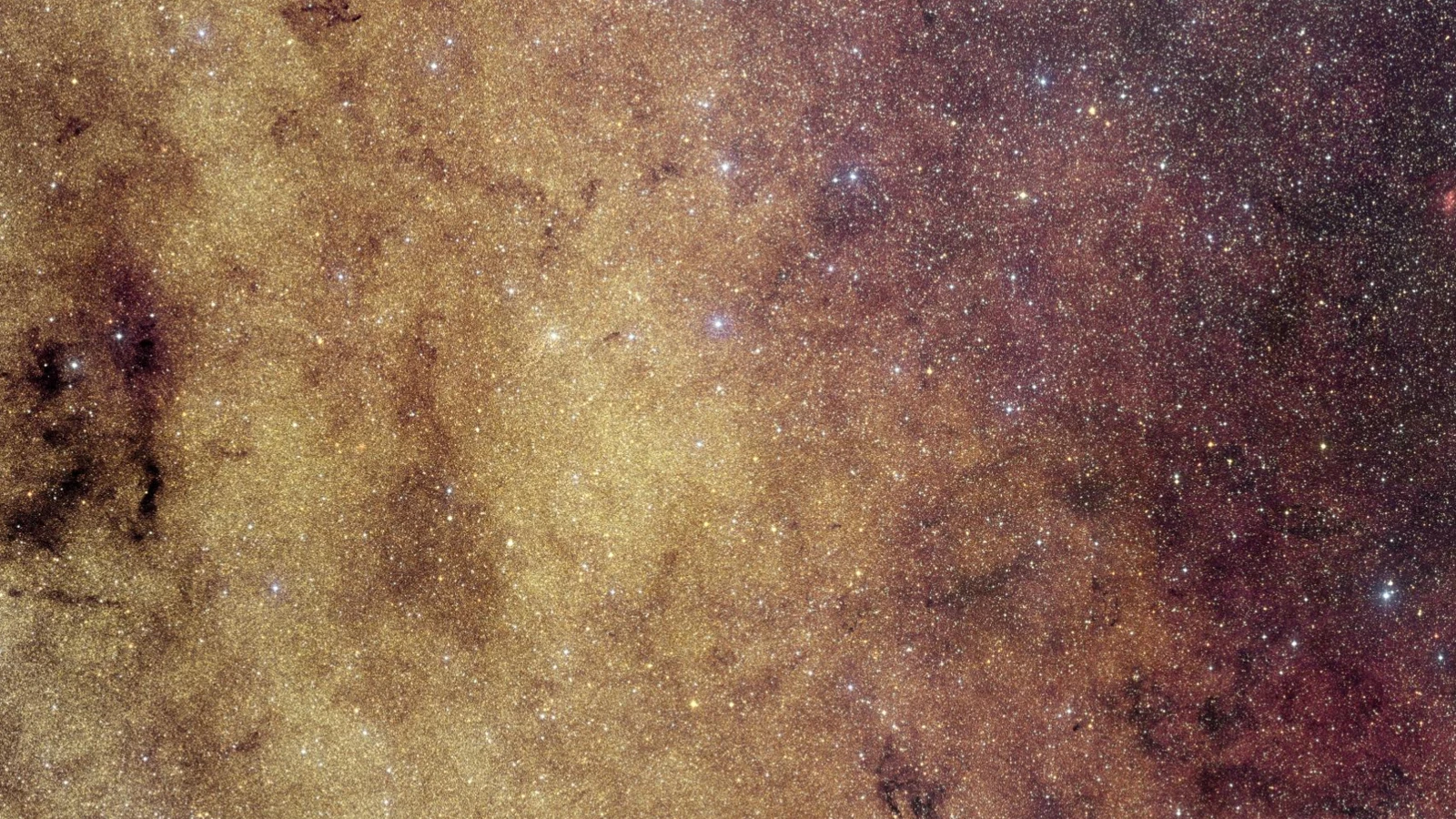
The Euclid telescope, which started its space journey in 2023 with the aim of solving the biggest mysteries of the universe such as dark matter and dark energy, has achieved a huge visual and scientific success that will revolutionize space studies. The new map, published by the European Space Agency (ESA), was obtained by turning the telescope’s advanced visible light camera onto the dense bulge at the center of the Milky Way Galaxy. The resulting mosaic was the largest and most detailed photograph of the sky ever taken, with 60 million stars.
NINE MOON-SIZE MAP IN 26 HOURS
Located 1.5 million kilometers away from Earth, Euclid shot continuously for 26 hours in March 2025 to obtain this fascinating image.
The resulting huge map was created by combining 9 separate photographs, each covering an area larger than the Moon in the sky.
Color was added to the keyframe, recorded in black and white by Euclid, using observation data from the Canada-France-Hawaii Telescope in Hawaii.
CHASING NEW WORLDS WITH THE “COSMIC MAGNIFICANT”
Scientists say that this historical work does not only offer a visual feast; He emphasizes that this dense region, home to billions of stars, is a perfect laboratory for hunting for exoplanets (planets outside the Solar System).
Although the photo did not directly discover a new planet, it contains critical data about the 51 currently known planetary systems and plays a key role in finding new worlds waiting to be discovered in the future.
HOW DOES THE MICROMELENSING METHOD WORK?
To precisely measure the mass of planets, experts use a method called “microlensing”:
-The light of a star behind is bent and brightened by the gravitational force of another star in front.
-If there is a planet orbiting the front star, a small deviation occurs in this light.
-Scientists can precisely calculate the mass of planets by examining these millimetric deviations.
A Century of Work Fitted into 26 Hours: Experts point out that this gigantic scan and mapping of 60 million stars, which would have taken thousands of hours if attempted to be done with telescopes on earth, was completed by Euclid in just 26 hours in space.
IT WILL GUIDE THE SPACE MISSIONS OF THE FUTURE
This historical record signed by Euclid will form the basis of not only today’s but also future space research. This map will be used as both a historical reference point and a reliable mass measurement guide for future exploration by cutting-edge instruments such as NASA’s Nancy Grace Roman space telescope.
