
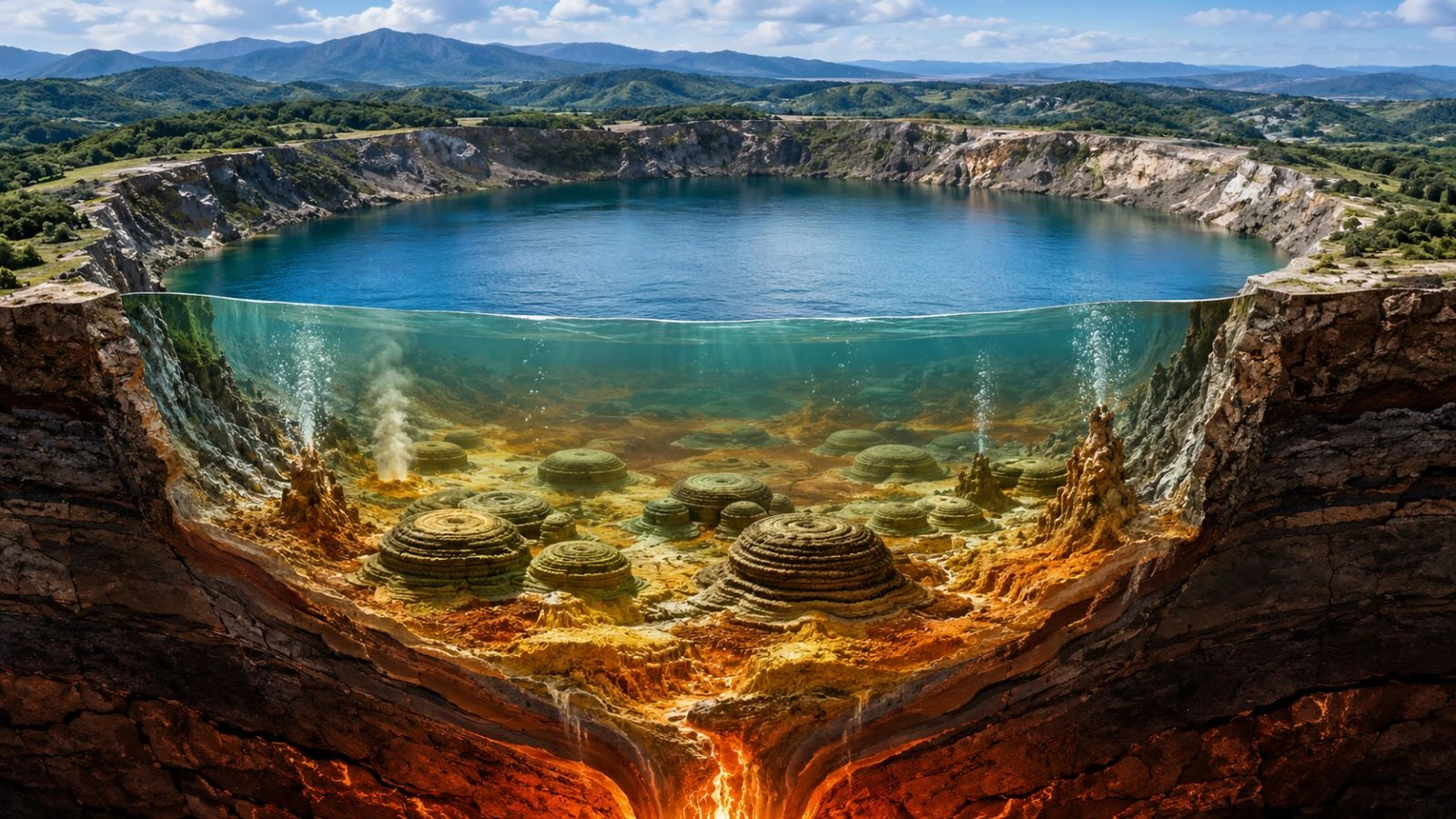
A team of researchers in South Korea has made a remarkable discovery about how life may have made its way on Earth. Stromatolites, structures formed by microbial communities that are among the oldest known traces of life on our planet, were found beneath the Hapcheon Crater, which was formed by an asteroid impact approximately 42 thousand years ago.
However, this discovery does not mean that the asteroid brought life from space. On the contrary, what the finding suggests is something else: The impact may have created a hot, mineral-rich environment similar to a hydrothermal system. In this environment, microbes may have found shelter and thrived for thousands of years.
Crater turned into a shelter for microbial life
The discovery was made in the Jeokjung-Chogye basin, located inside the Hapcheon Crater. Scientists detected different stromatolites here, with diameters ranging from 10 to 20 centimeters. Radiocarbon dating on one sample showed that these structures were formed between 23,400 and 14,600 years ago. This suggests that the lake formed after the impact maintained conditions suitable for life for a very long time.
The researchers also found chemical signatures indicating intense hydrothermal activity. Among these, the presence of the element europium, which becomes much more soluble in hot liquids, stands out. In addition, high levels of calcium, calcite and sulfur were also detected, which are linked to microbes adapting to warm environments. All these findings show that the crater is not just a geological scar; It also supports that it may have served as a kind of oasis for microscopic life forms.
The significance of this discovery goes far beyond this particular site in South Korea. According to the research team, if similar processes occurred on early Earth, asteroid impacts may have created numerous small refuges in which the first microbial ecosystems could settle and thrive.
What can this discovery tell us about Earth and Mars?
Stromatolites are very valuable from a scientific point of view. Because they are closely related to some of the oldest life forms on the planet. Specimens with an age of up to 3.5 billion years are known. Therefore, the presence of these structures in a crater indicates that asteroid impacts are not only destructive; It shows that in some cases, life can create perfect conditions in which it can find opportunities.
Additionally, the study raises an even more interesting possibility: These heatstroke lakes may have acted like small “oxygen islands.” So long before the Earth’s atmosphere completely changed, they may have supported the development of microbes that could produce oxygen. This is not conclusive evidence of how the Earth is oxygenated; but it adds a new piece to a puzzle that is still largely missing.
On the other hand, this study also turns our eyes beyond the Earth. If an impact crater here could preserve traces of microbial life, it is not unreasonable to look for similar traces on Mars. Now it remains to be seen whether robots probing the Martian surface can detect anything similar to what’s found here.
