
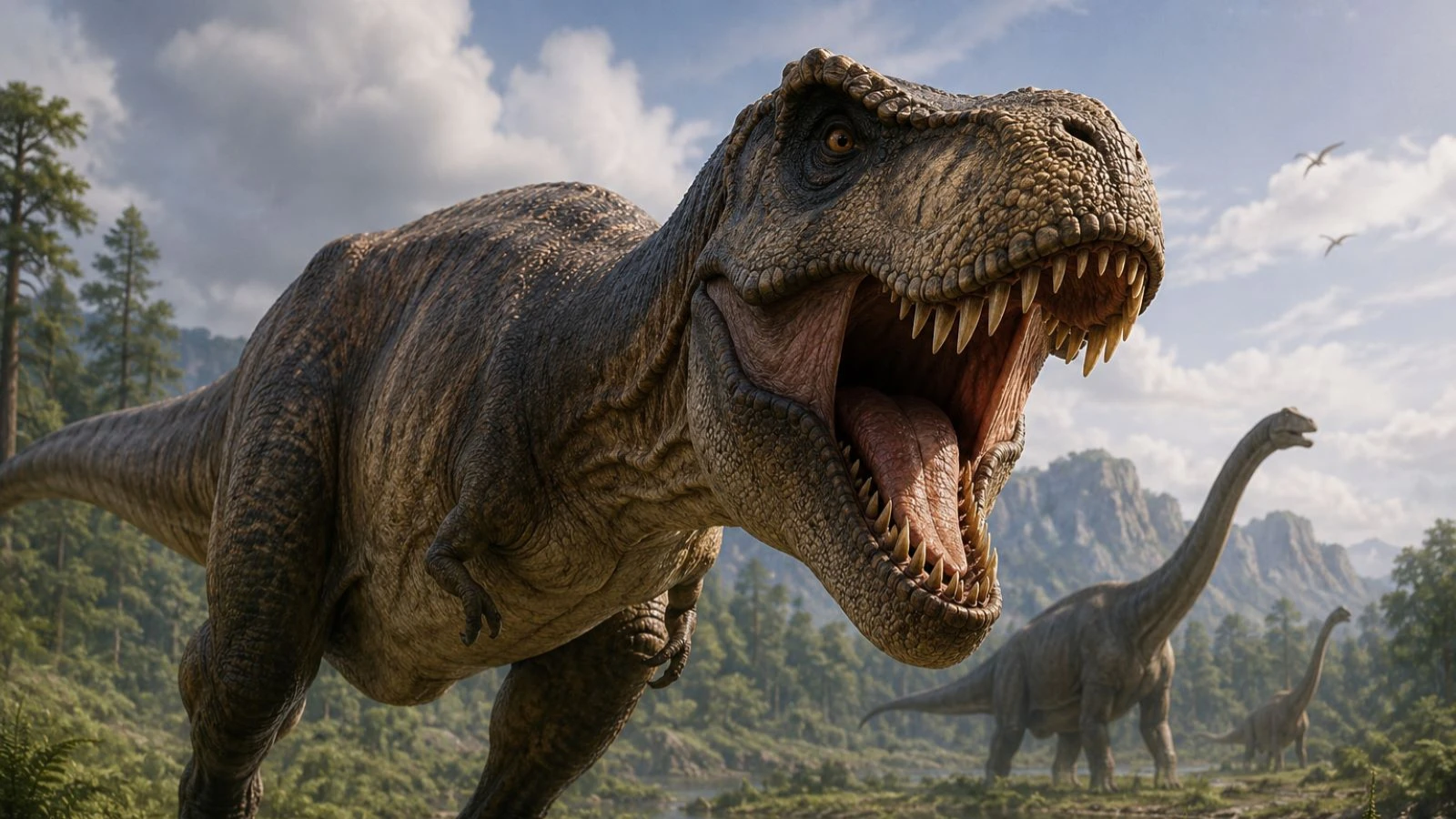
When T-rex is mentioned, one of the first features that comes to mind is its arms, which are quite small compared to its giant body. Scientists have been trying to understand why these arms have become so small for a long time. A new study conducted by researchers at University College London and Cambridge University in England offers a remarkable answer to this question.
According to the study, the shrinkage of forelimbs in T-rex and some other carnivorous dinosaur species was not a natural consequence of overall body size. The main determining factor was the strong head and jaw structure, which were increasingly used in hunting. In other words, these dinosaurs began to rely not on their arms to catch prey, but on their increasingly powerful skulls and jaws.
“The head replaced the arms”
In the study published in the journal Proceedings of the Royal Society B, 82 theropod species were examined. Theropods constitute a group of dinosaurs that mostly walked on two legs and were largely carnivorous.
Researchers determined that shortening of arms was not limited to tyrannosaurs. Similar shrinkage was seen in other large carnivorous dinosaurs, such as Carnotaurus. In fact, the study emphasized that Carnotaurus’ arms were even smaller than those of T-rex.
Charlie Roger Scherer, the lead author of the study, explains this change with the principle of “use it or lose it.” Accordingly, the arms that were no longer useful for hunting became smaller over time; The powerful head and jaw became the main tools of attack.
Stronger jaw against giant prey
According to the study, the growth of prey may also be behind this evolutionary change. Sauropods, giant long-necked herbivores, and other large dinosaurs may have forced carnivorous species to develop more effective attack methods.
According to the researchers, it was much more effective to attack a 30-meter-long sauropod with its powerful jaws rather than trying to hold it with claws. For this reason, while the arms remained in the background in some predatory dinosaurs, the skull became more durable and strong.
Scientists do not present this relationship as a definitive cause-effect connection. But the data shows a clear connection between a strong skull and short arms. According to the researchers, it seems more logical from an evolutionary perspective that the strong jaw structure developed first and the arms became smaller later.
T-rex tops the list
The research team developed a new method to measure skull strength. In this measurement, factors such as the connections of the skull bones, the shape of the skull and bite force were taken into account.
According to the results, T-rex received the highest score in terms of skull strength. He was followed by the Tyrannotitan, who lived in present-day Argentina. Tyrannotitan was a giant carnivorous dinosaur that lived more than 30 million years before T-rex.
Evolutionary arms race
Researchers describe this process as a kind of “evolutionary arms race.” As prey grow larger, the predators that hunt them are thought to develop stronger skull and jaw structures.
The study also stated that the arms did not shrink in the same way in every dinosaur group. In some species, the area below the hand and elbow shrank more, while in tyrannosaurs, all parts of the forelimb shrank more evenly.
This suggests that a similar result, small arms, may have arisen through different evolutionary paths in different groups of dinosaurs.
