
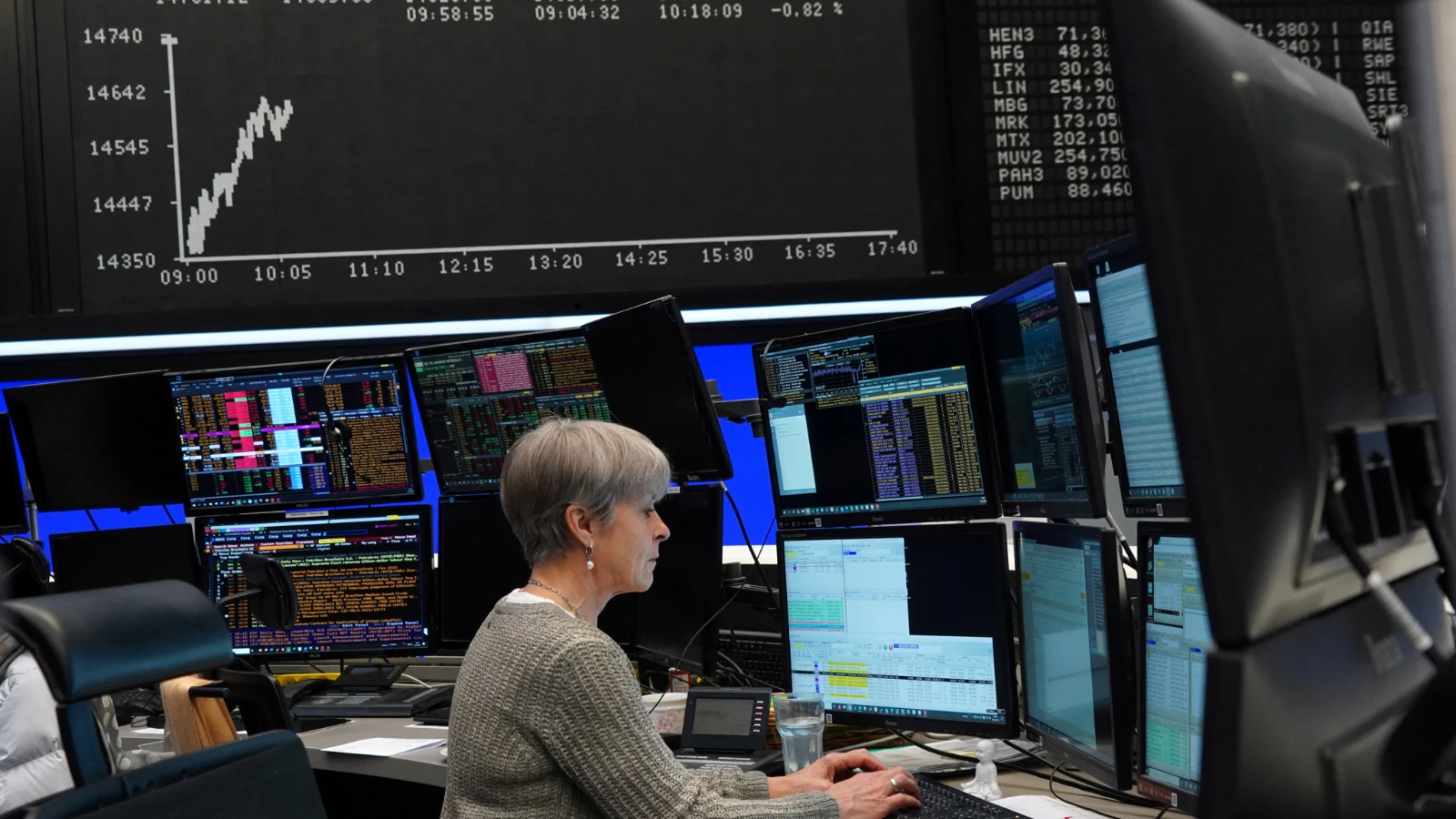
European stock markets are following a positive trend due to the increasing optimism about the agreement in the Middle East and the impact of strong company balance sheets.
US President Donald Trump’s decision to briefly suspend the Freedom Project, which is described as an aid initiative for the passage of ships stuck in the Strait of Hormuz, and his declaration that great progress has been made towards reaching a final agreement with Iran, revived the risk appetite in the markets.
Strong company balance sheets also gave additional impetus to the markets, led by technology stocks.
In European markets, as of 10.15, the Stoxx Europe 600 indicator index is at 617 points, with a 1.3 percent increase, and the FTSE 100 index in the UK is at 10,370 points, with a 1.5 percent increase.
In Germany, the DAX 40 index is at 24,733 points with a 1.4 percent gain in value, in Italy the FTSE MIB 30 index is at 49,232 points with a 1.4 percent premium, in France the CAC 40 index is at 8,170 points with a 1.4 percent increase, and in Spain the IBEX 35 index is at 17,907 points with a 1.4 percent gain.
While the rise in energy prices in the region continues to be one of the main agenda items, European Union (EU) Commission Member Responsible for Energy, Dan Jorgensen, pointed out the risks in the energy markets and said that they are preparing for scenarios where supply security problems may arise regarding jet fuel.
Pointing out that there have been extraordinary geopolitical fluctuations recently, Jorgensen said, “The world is undoubtedly facing one of the most serious energy crises ever. This crisis tests the resilience of our economies, societies and partnerships.” he said.
On the other hand, the motion of no confidence submitted to the parliament by PSD, the largest party in Romania, the far-right AUR and PACE-Priority Romania, was accepted by majority vote. Thus, the government led by Prime Minister Ilie Bolojan fell.
Analysts stated that in the rest of the day, developments in the Middle East and energy prices, as well as ADP private sector employment in the USA, Producer Price Index (PPI) and service sector and composite Purchasing Managers Index (PMI) data in the Eurozone will be followed.
