
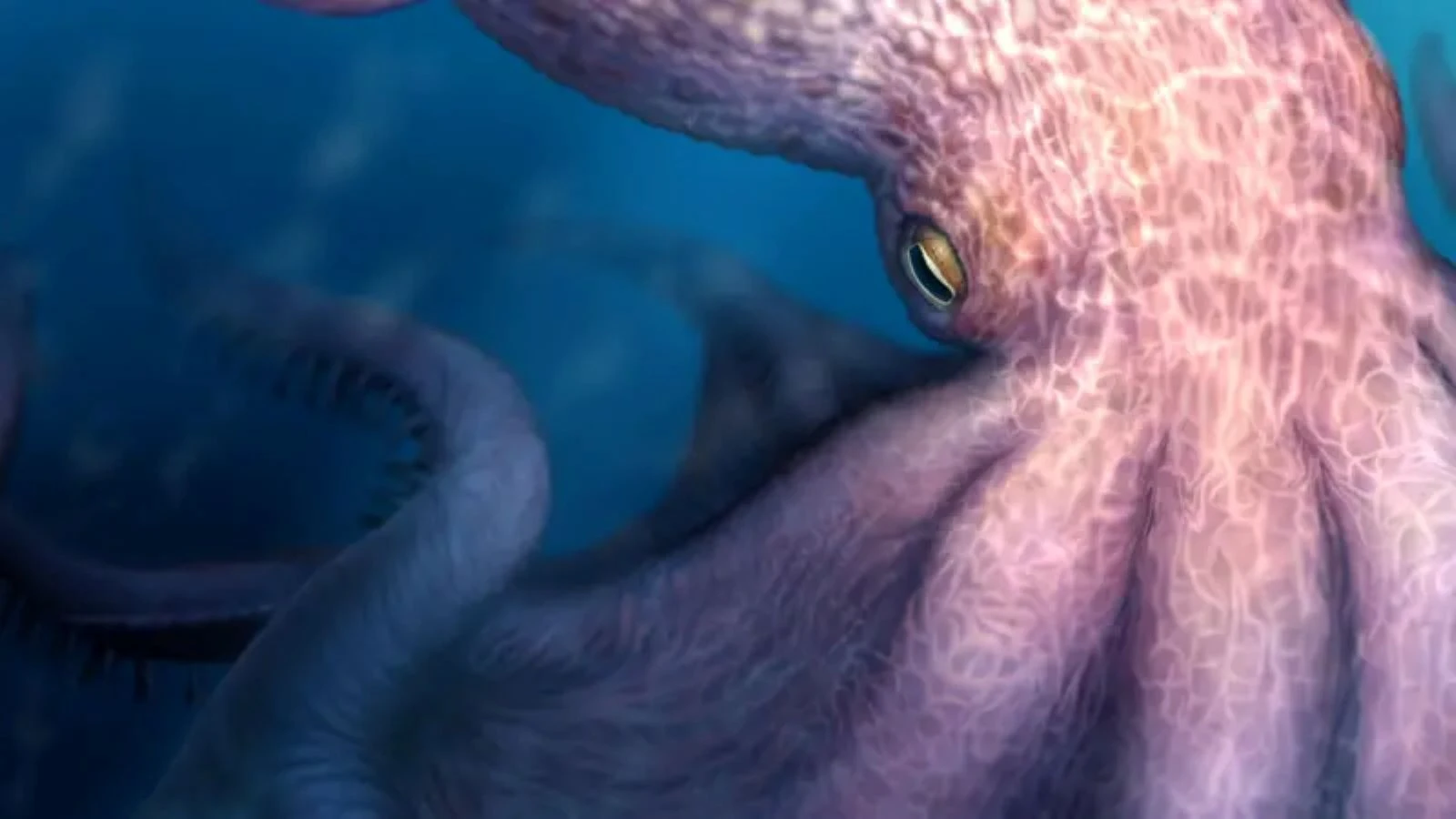
The story of prehistoric oceans is changing with a new discovery that seems straight out of a science fiction novel. The first octopuses to live on this planet were not small and modest creatures as we think; On the contrary, they were giant predators that could reach up to 20 meters and were at the top of the food chain.
This discovery, published in the journal Science, forces us to reconsider who really dominated the Cretaceous seas.
Giant octopuses take to the stage
For many years, the prevailing view in paleontology was that the oceans were controlled by large reptiles and giant sharks. But an international team led by Hokkaido University has revealed that cephalopods also play an important role in this race.
Two species are at the forefront of this revolutionary discovery: Nanaimoteuthis jeletzkyi and Nanaimoteuthis haggarti.
The remains of these creatures were found in sediments in the North Pacific, and for the first time, both their size and lifestyle have been reconstructed in detail.
Strong and intelligent hunters
According to the research, these octopuses were active predators and extremely strong. They probably had high intelligence.
The key to these results is hidden in their jaws. Excessive wear, cracks and fractures were detected in the fossils. This shows that these creatures regularly break down hard prey such as shells and bones.
So these octopuses were not opportunistic, but active and aggressive hunters.
Detail indicating brain development
The wear on the jaws is not symmetrical. This shows that one side is used more than the other.
In today’s animals, this type of “unilateral use” is associated with advanced brain functions. This indicates that giant octopuses may be not only powerful, but also creatures that can display complex behaviors.
Their size rivaled that of giant predators
Researchers estimated the length of these creatures using the jaw-size relationship.
Accordingly, N. haggarti species could grow between 6.6 and 18.6 meters. This puts them on par with the giant predators of the Cretaceous. For example, they reached similar sizes to marine reptiles such as Mosasaurus hoffmannii. So these octopuses were not an exception, but one of the dominant species of the period.
A new picture in the evolutionary race
The discovery also reveals an important point about evolution. Over millions of years, vertebrates accelerated by shrinking their external structures. Cephalopods lost their shells and became more flexible.
This “evolutionary convergence” suggests that similar solutions have emerged to reach the top of the food chain.
Invertebrates weren’t just prey
This discovery also challenges the idea that invertebrates fall prey only to large predators.
During the Cretaceous period, many creatures developed thicker shells to defend themselves. However, these new findings reveal that some species did not just remain defensive, but also turned into attacking and dominating creatures.
A wilder and more competitive ocean
The new picture that emerges points to a much harsher ecosystem.
In this world, sharks, giant marine reptiles, large fish, and whale-sized octopuses hunted and competed in the same environment.
There are still unanswered questions
It is still unknown how these giant creatures interact with each other. Although fossils cannot show direct conflict, it is clear that they competed for the same resources.
Artificial intelligence makes fossils talk again
The research also reveals the importance of new technologies. Thanks to digital modeling and artificial intelligence, scientists can analyze fossils in more detail and identify new specimens without physical excavation. In this way, previously inaccessible information about the past is brought to light.
