
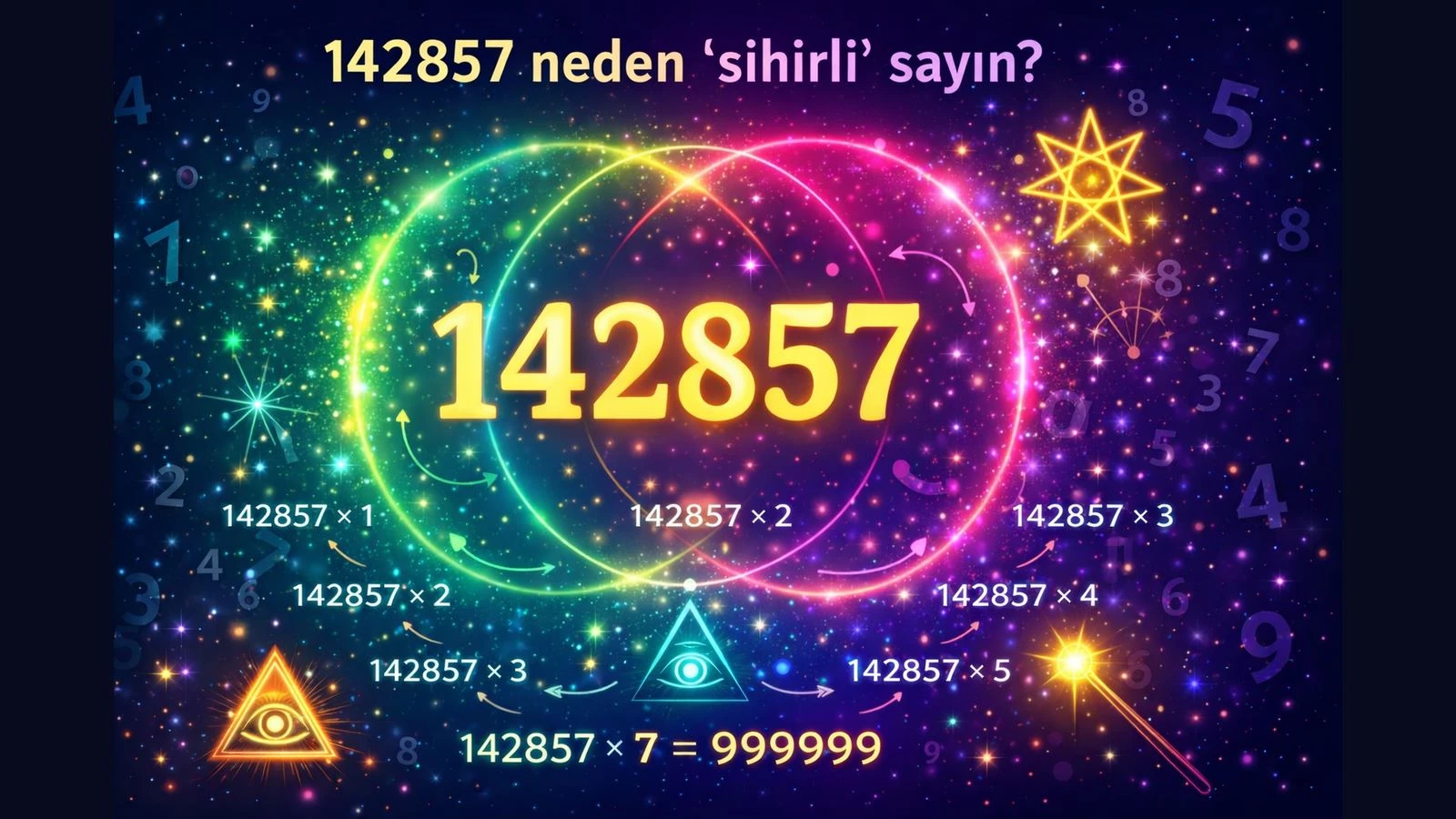
On a more basic level, this number has become one of the classics of fun mathematics. It became popular thanks to names such as Martin Gardner and Shakuntala Devi, the Indian mental calculation master known as the “human computer”, and showed that mathematics could be fun for everyone.
This issue even appears in American author Don DeLillo’s cult novel Ratner’s Star (1976). In the novel, scientists try to decipher a six-digit message from a distant star in the Milky Way: 142857.
It’s also very attractive for magicians; because the properties of this number allow creating the illusion of mind reading or predicting the outcome.
For example, a simple trick. Tell someone on the phone to type 10101 into the calculator.
Then ask him to multiply it by a number between 1 and 6, then divide by 7 and multiply by 99.
You can say with certainty that the result will definitely contain the numbers 1, 2, 4, 5, 7 and 8.
So what makes this number so interesting?
We can call it the cyclic number property.
Let’s start multiplying 142857:
142857 × 1 = 142857
142857 × 2 = 285714
142857 × 3 = 428571
142857 × 4 = 571428
142857 × 5 = 714285
142857 × 6 = 857142
Did you notice? All results consist of the same numbers, only their order changes.
That’s why 142857 is called a cyclic number in mathematics. So when you multiply a number by the numbers 1 through n, you get rotated versions of your numbers.
This acts as if the figures were connected by an invisible circular string.
The magic relationship with 7
142857 × 7 = 999999
This is no coincidence. Because 1 ÷ 7 = 0.142857142857…
So 142857 is the repeating decimal part of the fraction 1/7.
More interestingly, the same numbers repeat with different starting points in the 2/7, 3/7, 4/7, 5/7 and 6/7 operations.
So when you multiply by 7, the result is 999999 — a reflection of 0.999999…, which is actually mathematically equivalent to 1.
Other interesting features
Some fun roundups:
14 + 28 + 57 = 99
142 + 857 = 999
1428 + 5714 + 2857 = 9999
The resulting order is remarkable.
If you also add a 9 in the middle of the number (1429857), similar cyclic properties are preserved.
What happens after 7?
142857 × 8 = 1142856
At first glance, order appears to be broken.
But if you take the first digit and add it back:
1 + 142856 = 142857
So the number returns to itself again.
This situation continues for multiplications such as 9, 10, 11. Especially in multiples of 7, the 999999 pattern is reached again.
larger examples
142857 × 142857 = 20408122449
When you take 6 digits from the right and add them to the remainder…
122449 + 20408 = 142857
So the number returns to itself again.
Just this number?
No. There are other cyclic numbers as well.
For example:
1 ÷ 17 = 0.0588235294117647…
This number is also cyclic and consists of 16 digits.
The general rule is this: Cyclic numbers are often associated with prime numbers.
Number of digits = 1 less than the prime number
For example:
7 → 6 digits (142857)
17 → 16 digits
mathematical meaning
Not every prime number produces cyclic numbers, but all cyclic numbers are related to prime numbers.
For this property to occur, dividing 1 by a number must yield a repeating decimal sequence with length (prime number – 1).
In this way, the numbers rotate perfectly and the cycle is never broken.
Source: BBC MUNDO
